
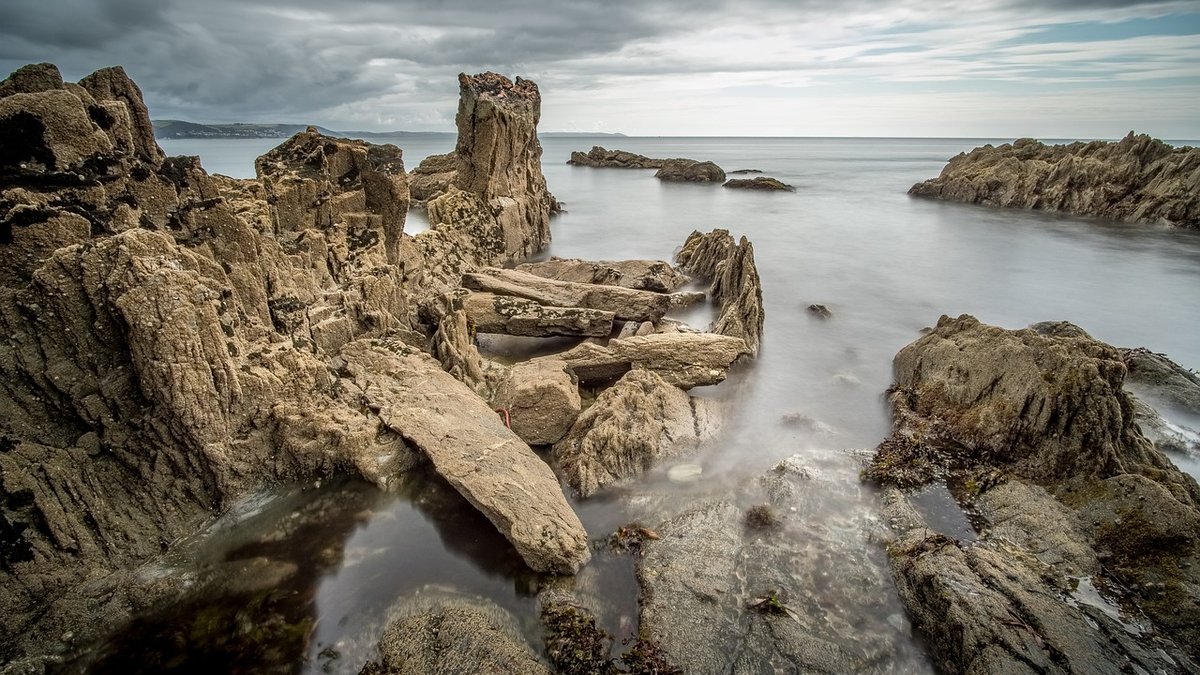
Beachcombing is less about luck than about attention. Every tide sorts and re-sorts whatever the sea has carried, and the objects that end up at your feet — a curve of frosted glass, a scrap of blue-and-white china, the leathery purse of a skate — each hold a small piece of local history. Learning to read them turns an ordinary walk into something closer to a conversation.
Timing matters. Head out on a falling tide and aim to reach the low-water mark about an hour before low tide, then follow the water back up as it turns. The richest pickings usually arrive after a spring tide or a winter gale, when the strandline — the ribbon of debris at the top of the beach — is freshly laid. Early morning helps too: you get the best of the light and the first look before anyone else.
Sea glass is the beachcomber's gateway find, and its colours say something about the place. Greens, browns and frosty whites are the everyday glass of beer, wine and windows. Cobalt blue is uncommon and often points to old medicine or poison bottles. Reds, ambers and deep greens are the rarest of all, frequently from nautical lights, ship's lanterns or Victorian tableware.
Genuinely old glass has soft, rounded edges and an even, almost soapy frost. Sharp edges mean it is recent. Look on shingle, gravel and in small coves rather than on fine sand, particularly below old harbour walls, slipways and former tip sites where household waste was once tipped straight over the edge.
The dark, leathery rectangles sometimes called mermaid's purses are the empty egg cases of skates and rays. Thornback, blonde and spotted ray cases each differ slightly in shape and size, and every species has its own preferred nursery ground. Smaller cases with long, curling tendrils usually belong to dogfish. Cuttlefish bone, whelk egg cases — the papery "sea wash balls" — and by-the-wind sailors all turn up in the same tideline.
These are records, not rubbish. Note the date, the beach name and a grid reference if you can, photograph the case against something for scale, and pass the details to a marine recording scheme in your area. That data helps map where these animals breed, which is genuinely useful. Then put it back or leave it where it lies; a dry case crumbles within days and is far more valuable on the beach than on a windowsill.
Worn pottery is the quiet historian of the coast. Fragments of blue-and-white transferware, sponge-patterned earthenware and plain white china were once domestic ware, and a surprising amount reached the sea through old tips, harbour works and shipwrecks. Thin, pale stems of clay tobacco pipes are another common find; they were cheap, easily broken and scattered liberally along working coastlines.
Larger pieces of brick, roof tile and kiln waste can point to a nearby works or a lost harbour wall. Sea coal — smooth, light, black pebbles — usually signals a collier trade or a coal tip. Amber and jet are rare but do appear on some eastern coasts; both feel warm and light in the hand, and jet leaves a brownish streak when drawn across unglazed tile. Keep an eye out too for sea beans, the hard tropical drift seeds that can travel for years on the current.
Take photographs freely, and take objects sparingly. In the UK, removing sand, shingle or stones is restricted or prohibited on many beaches, and collecting natural material is not permitted on protected sites such as Sites of Special Scientific Interest. Never dig into cliffs, dunes or archaeological earthworks, and never prise anything from a rock pool.
A notebook or a simple spreadsheet is all you need, and the habit pays off within a season. For each find, jot down the date, the beach, the state of the tide, the weather over the preceding few days and a rough grid reference. Photograph the object next to a coin or ruler on a plain background, then describe it in a line or two.
Over a year, patterns emerge: which wind brings sea glass to a particular cove, when the mermaid's purses appear, where the china congregates after a storm. That log becomes a record of your own stretch of coastline, and it is often more interesting than the objects themselves. Beachcombing well is really just paying attention — and leaving the beach in a state to tell its story again tomorrow.

Hi, my name is Anthony kuber. I am artist and fashion designer.
I love to travel and writing blogging.
Your email address will not be published. Required fields are marked *
Software Developer & Writer
Hey, I'm Diva, a developer and writer blending code and creativity. I'm driven by a deep curiosity and a relentless pursuit of excellence. Join me as I craft digital solutions and captivating stories.


